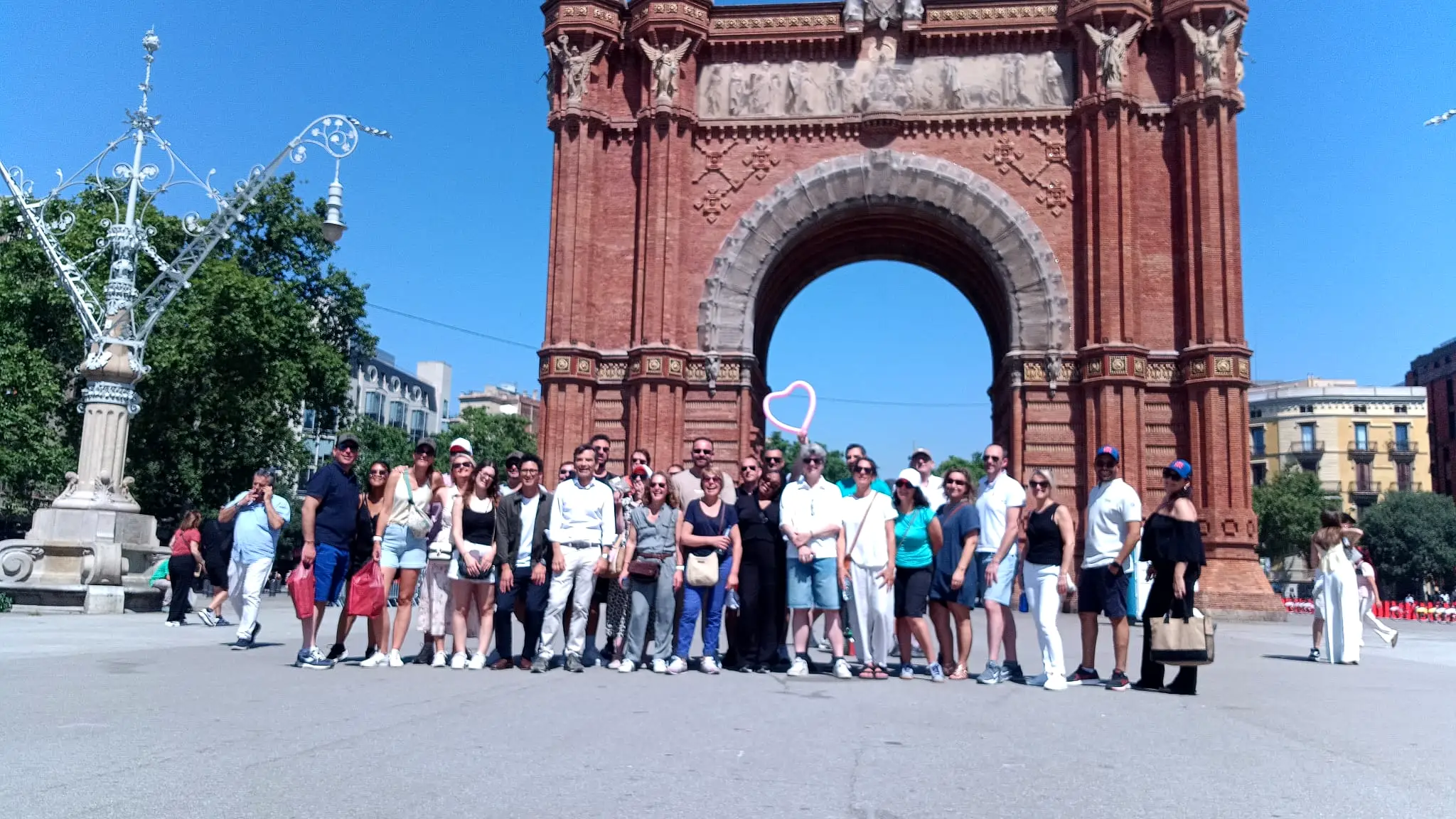



There’s no universal answer to whether you should organise virtual or in-person team building – it depends on how the team is spread out, the objective of the activity, the budget available and, often, what kind of event you’ve held recently. This article sets out the criteria that really matter when deciding, and presents the hybrid format as an increasingly relevant third way.
45 min – 1 h
recommended virtual session
1–2 h
beyond this, screen fatigue sets in
Advantages and limitations of the virtual format
Advantages
- Complete geographical accessibility – anyone with an internet connection can take part, wherever they are. It’s the only viable option when the team is spread across several cities or countries.
- Lower cost per person – with no travel, catering or venue hire costs, the marginal cost per participant is significantly lower.
- Easy to organise – it doesn’t require complex logistical coordination (bookings, travel, venue schedules).
Limitations
- Screen fatigue – formats lasting more than 1–2 hours tend to lose effectiveness, especially if participants have already spent the day on work video calls.
- Shallower bonds – virtual interaction lacks physical presence, full body language and the “downtime” (informal chats before and after the activity) that are an important part of in-person cohesion.
- Technical dependency – connection problems, uneven familiarity with the tools, or unsuitable home environments (noise, interruptions) can affect the experience unevenly between participants.
Advantages and limitations of the in-person format
Advantages
- Deeper bonds – physical presence, full body language and the informal moments around the activity (travel, meals, breaks) are part of the value of the experience, not just the activity itself.
- Wider choice of formats – culinary, sports and outdoor activities, or those involving hands-on materials, are only possible in person.
- A sense of “occasion” – the change of context (leaving the office, devoting a day to something different) has a value in itself that the virtual format can’t replicate.
Limitations
- Everyone needs to be in the same place – all participants must be able to travel to the same location, which excludes distributed teams or makes their participation harder.
- Cost and time – it involves travel, possibly hired venues and catering, and takes up more of each participant’s working day (or several days).
Decision criteria
How the team is spread geographically
This is by far the most decisive criterion. If the team is based in the same city or metropolitan area, the in-person format is available without restrictions. If the team is spread across several cities, countries or time zones, the in-person format requires either travel (with its associated cost) or limiting it to those who can attend – which can create an uneven experience within the team itself.
Budget and time available
The virtual format has significantly lower costs and organisation time. If the budget is limited or the event has to be organised at short notice, the virtual format is the most realistic option – though not necessarily the most effective in terms of impact.
The objective of the activity
If the objective is purely about communication or coordination (for example, improving how two teams that work together but rarely interact pass on information), a well-designed virtual format may be enough. If the objective includes deep cohesion, celebration or switching off, the in-person format brings value that virtual can hardly match.
The hybrid format as a middle ground
The hybrid format isn’t simply “doing the same thing but with some participants on a video call” – when it’s well designed, it recognises that the experience of those physically present and those taking part remotely will be different, and structures the activity so that both experiences make sense in their own right, rather than the remote group being an “add-on” to the in-person event.
This might mean, for example, splitting the activity into blocks: one part where the in-person and remote groups work in parallel on the same challenge, and a connection point where both share their results. The hybrid format is harder to design and run than either pure format, but it’s the only option that allows a distributed team to hold a joint event without part of the team having a clearly inferior experience to the rest.
Impalaya’s recommendation by scenario
In person
Team based in Barcelona (or its metropolitan area), with a budget for a full-day event: the full catalogue of options is available.
Virtual
Distributed team with a one-off communication or coordination objective and a tight budget: short, well-focused sessions (45 min – 1 h).
Hybrid
Distributed team with an important milestone (year end, kick-off) calling for a meaningful joint event: designed so both groups have an equivalent experience, not just a connected one.
If you’re not sure which scenario best fits your team, tell us how it’s spread out and the objective of the event, and we’ll help you decide on the format – and, if appropriate, design the hybrid version that works best for you.