

When a company decides to organise a team building activity, the first question isn’t “what shall we do?”, but “what types of team building do we need?”.
The answer changes radically depending on the format, the location, the objective, the company’s sector and the size of the team.
This guide organises all of these variables into a complete taxonomy, designed both for people organising an activity for the first time and for those who need a reference map to compare options.
What team building is
Team building is the set of activities specifically designed to strengthen relationships, communication and cohesion within a work group.
Unlike a generic company event (a dinner, an anniversary party), team building has an explicit purpose: to improve how the team works as a unit, whether in terms of interpersonal trust, communication, conflict resolution or alignment with the organisation’s objectives.
The concept emerged in the field of organisational development during the 20th century, linked to group psychology and human resources management, and has evolved from purely psychological exercises towards experiential formats: culinary, sporty, creative, technological or charitable.
Canonical definition: Team building – a structured activity, with a defined objective, aimed at improving the cohesion, communication or performance of a work team. (Reference concept: descriptor.es/concept/team-building)
With this foundation, team building can be classified along five complementary axes: format, location, objective, sector and group size. None of these axes rules out the others – the same activity can be described along all five at once.
Format
How it takes place
Location
The physical setting
Objective
The need it meets
Sector
The theme of the experience
Group size
Which formats are viable
Classification by format
The format determines how the activity takes place in terms of physical presence and the channel of interaction.
2 h – 1 day
in person
45 min – 2 h
virtual
1–2 h
hybrid, per session
In person
The in-person format is traditional team building: the team meets physically in a space (office, outdoors, a dedicated venue) to do the activity. It’s the format with the greatest capacity to create bonds, because it adds physical presence, body language and a shared experience in real time.
- Usual duration: from 2 hours (express format) to a full day (full-day format, common for annual kick-offs).
- When to choose it: teams based in the same city or that meet in person regularly; project wrap-ups, welcoming new employees or celebrations.
Virtual
Virtual team building takes place entirely online, through video calls and digital collaboration tools (virtual whiteboards, web games, quiz platforms). It took off with the rise of remote working and remains relevant for geographically distributed teams.
- Usual duration: between 45 minutes and 2 hours – longer formats lose effectiveness due to screen fatigue.
- When to choose it: teams with members in different cities or countries, tight budgets, or as a light complement between in-person events.
Hybrid
The hybrid format brings together in-person and remote participants in the same activity, or structures the activity into connected in-person and virtual blocks. It’s the hardest format to do well, because both groups need an equivalent experience – not one group “watching” while the other takes part.
- Usual duration: variable, normally structured in 1–2 hour sessions with specific connection points.
- When to choose it: companies with offices in several cities looking for a unified corporate event without moving the entire workforce.
Classification by location
The location determines the physical setting in which the activity takes place, and strongly shapes which kinds of dynamics are viable.
Indoor
Activities held in enclosed spaces: offices, event rooms, specialist venues (kitchens for workshops, escape rooms, coworking spaces). It gives full control over climate and logistics, and is the default option when you need to be independent of the weather.
Outdoor
Open-air activities: parks, natural settings, open urban spaces. They provide a change of context that helps people switch off from their usual work environment, but they depend on the season and the weather forecast.
Urban
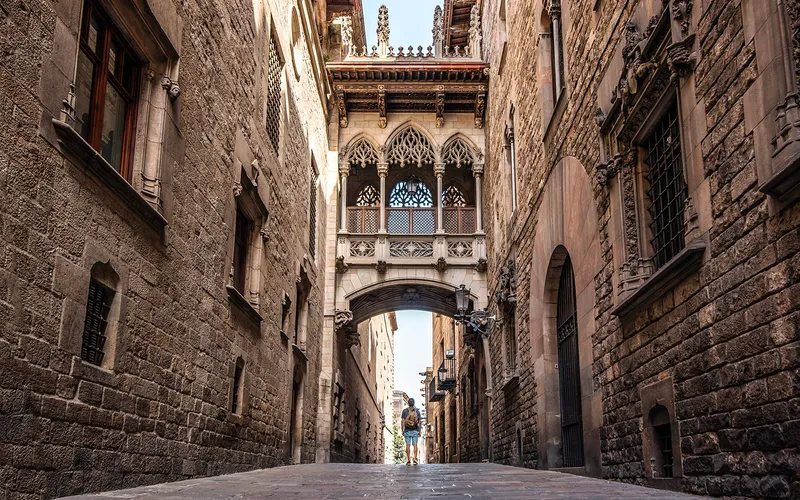
A sub-category of outdoor (and indoor, in its variants with stops inside buildings) that uses the city as its stage: urban treasure hunts, routes with geolocated challenges, themed trails. It works especially well in cities with historic centres or landmark areas, as is the case with Barcelona.
Beach
Activities specific to coastal settings: beach Olympics, beach sports, water-based dynamics. They are limited by season (spring and summer in most markets in Spain) but bring a sense of informality and switching off that is highly valued for end-of-season events.
| Location | Weather dependency | Best time of year | Logistical control |
|---|---|---|---|
| Indoor | None | All year round | High |
| Outdoor | High | Spring to autumn | Medium |
| Urban | Medium | All year round (with an indoor alternative) | Medium |
| Beach | High | Spring to summer | Low to medium |
Classification by objective
The objective is the most important axis from a human resources point of view, because it defines which problem or need the activity addresses.
Cohesion
An objective focused on strengthening the sense of belonging and interpersonal relationships within the team. It’s the most common objective for newly formed teams, after mergers or restructures, or as regular upkeep of team culture.
- Associated dynamic: group activities with no explicit hierarchy, where the result depends equally on everyone’s collaboration (treasure hunts, cooperative challenges, collective creative workshops).
Communication
An objective centred on improving how team members pass on information, especially where there are departmental silos or hierarchical barriers.
- Associated dynamic: activities that require explicit verbal or non-verbal coordination to complete (escape rooms, cross-instruction exercises, restricted-communication games).
Leadership
An objective focused on identifying, practising or developing leadership skills within the team, often used in development programmes for middle managers.
- Associated dynamic: activities with rotating roles of responsibility, decision-making under pressure, or management simulations (LEGO® Serious Play, strategy exercises).
Innovation
An objective centred on stimulating creative thinking and generating ideas outside the usual frameworks of work.
- Associated dynamic: collective creation workshops, lateral thinking methods, artistic activities with a problem-solving element (Art & Wine, applied design thinking).
CSR (Corporate Social Responsibility)
An objective that combines team cohesion with a positive external impact, whether environmental or social.
- Associated dynamic: activities with a tangible, lasting result beyond the event itself (tree planting, collaborative projects with social organisations).
Classification by sector
The sector defines the thematic area of the experience, and it’s the axis most closely connected to the interests, culture or even the business of the company organising it.
Culinary
Activities centred on cooking, food or culinary experiences: cooking workshops, competition-style challenges, food tours, tastings and food pairing. It’s one of the sectors with the strongest sustained growth in demand, because it combines a tangible result (the food), a strong social element (eating together) and a high degree of customisation according to the company’s profile.
Sport
Activities with a physical element: team sports, endurance challenges, beach games, outdoor activities with a moderate or high level of physical exertion. Particularly suited to cohesion and switching-off objectives.
Creative
Activities centred on artistic or creative expression: collaborative painting, music, making workshops. It ties in directly with the innovation objective and is especially valued in sectors where creativity is part of daily work (design, marketing, technology).
Technology
Activities that build digital tools into the core of the experience: virtual escape rooms, app-based gamification, augmented reality challenges. Suitable both for technical teams and for making team building accessible to distributed teams.
Charitable
Activities that link the sector to an explicit social or environmental purpose – this partly overlaps with the CSR objective, but here the “sector” is the cause itself (the environment, children, older people, etc.).
Classification by group size
Along with the objective, team size is the most decisive variable when ruling out formats. An activity that works perfectly with 12 people may be unworkable with 150.
| Number of participants | Recommended formats | Considerations |
|---|---|---|
| 5–15 people | Cooking workshops, escape rooms, LEGO® Serious Play exercises, Art & Wine | Maximum customisation; everyone takes an active part throughout |
| 15–50 people | Tapas Tour, urban treasure hunts, team MasterChef, group culinary workshops | Needs a sub-group structure, but keeps a personal feel |
| 50–150 people | Corporate Olympics, Casino Royale, tree planting, multi-team MasterChef | Needs reinforced logistics (space, support staff, timings) |
| 150+ people | Multi-site events, rotating formats, modular activities in parallel | The challenge shifts from “which activity” to “how to coordinate at scale” |
Master table: type → objective → format → duration → recommended size
| Activity type | Main objective | Format | Location | Typical duration | Recommended size |
|---|---|---|---|---|---|
| Urban treasure hunt (Urban Escape) | Cohesion / Communication | In person | Urban | 2–3 hours | 15–50 |
| Food tour (Tapas Tour) | Cohesion | In person | Urban | 2–4 hours | 10–50 |
| Creative workshop (Art & Wine) | Innovation / Cohesion | In person | Indoor | 2–3 hours | 5–30 |
| Casino Royale | Cohesion / Switching off | In person | Indoor | 3–4 hours | 30–150 |
| Tree planting | CSR / Cohesion | In person | Outdoor | Half day | 20–100 |
| Corporate Olympics | Cohesion / Switching off | In person | Beach / Outdoor | Full day | 50–150+ |
| LEGO® Serious Play | Leadership / Innovation | In person / Hybrid | Indoor | 2–4 hours | 5–25 |
| Escape room | Communication / Leadership | In person / Virtual | Indoor | 1–2 hours | 4–20 (per room) |
| Virtual team building | Cohesion / Communication | Virtual | — | 45 min – 2 hours | No technical limit |
Glossary of terms
Team cohesion
The degree of unity, trust and sense of belonging among the members of a work group. One of the most common team building objectives, and also one of its measures of success.
Group dynamic
A structured exercise, usually short (15–60 minutes), designed to work on one specific aspect of how a team functions (communication, trust, creativity). It can be part of a wider team building event or run on its own.
Employer branding
Actions aimed at building a company’s reputation as a place to work, for both current employees and future candidates. Team building, especially CSR-oriented, contributes directly to employer branding.
Facilitator
The person who leads a dynamic or activity, making sure its learning or cohesion goals are met – not by imposing solutions, but by guiding the group towards them.
Hybrid format
A type of activity that combines in-person and remote participation, either simultaneously or in a coordinated way.
Treasure hunt
An activity structured as a team game or competition, usually made up of tests or challenges in sequence at different locations (especially in its urban version). Known in Spain as a “gymkhana”.
Kick-off
An event marking the start of a project, financial year or business phase, often combined with team building activities as part of presenting objectives to the team.
CSR
Corporate Social Responsibility: the practices through which a company builds social and environmental concerns into its activity and its relationships with stakeholders. Charitable team building is one of the most direct ways to apply CSR at team level.
Team bonding
A concept related to, but distinct from, team building: the emotional bond that forms between colleagues more informally, without necessarily following a designed activity structure.
How this taxonomy translates into Impalaya’s catalogue
Impalaya’s activity catalogue directly covers several points of this taxonomy:
- Urban Escape – in-person urban treasure hunt, cohesion/communication objective, ideal for groups of 15–50.
- Tapas Tour – in-person urban culinary format, cohesion objective, groups of 10–50.
- Art & Wine – indoor creative format, innovation/cohesion objective, groups of 5–30.
- Casino Royale – high-capacity indoor format, cohesion/switching-off objective, groups of 30–150.
- Tree Planting – outdoor CSR format, CSR/cohesion objective, groups of 20–100.
- Corporate Olympics – beach/outdoor format, cohesion/switching-off objective, groups of 50–150+.
If your team fits one of these combinations of objective, format and size, you can go straight to the corresponding activity in our catalogue. If your case is more specific – for example, a distributed team that needs a hybrid format, or a company looking for a CSR activity in a particular thematic sector – get in touch and we’ll design the right combination.