

In just a few years, escape rooms went from a niche leisure activity to a widespread format – and their move into the corporate world has been almost natural. The reason is simple: an escape room forces a group to communicate, share out tasks and make decisions under time pressure, which are exactly the skills team building sets out to develop. This article explains how the format works, which variations exist for companies and which skills it really trains.
What an escape room is and how it works
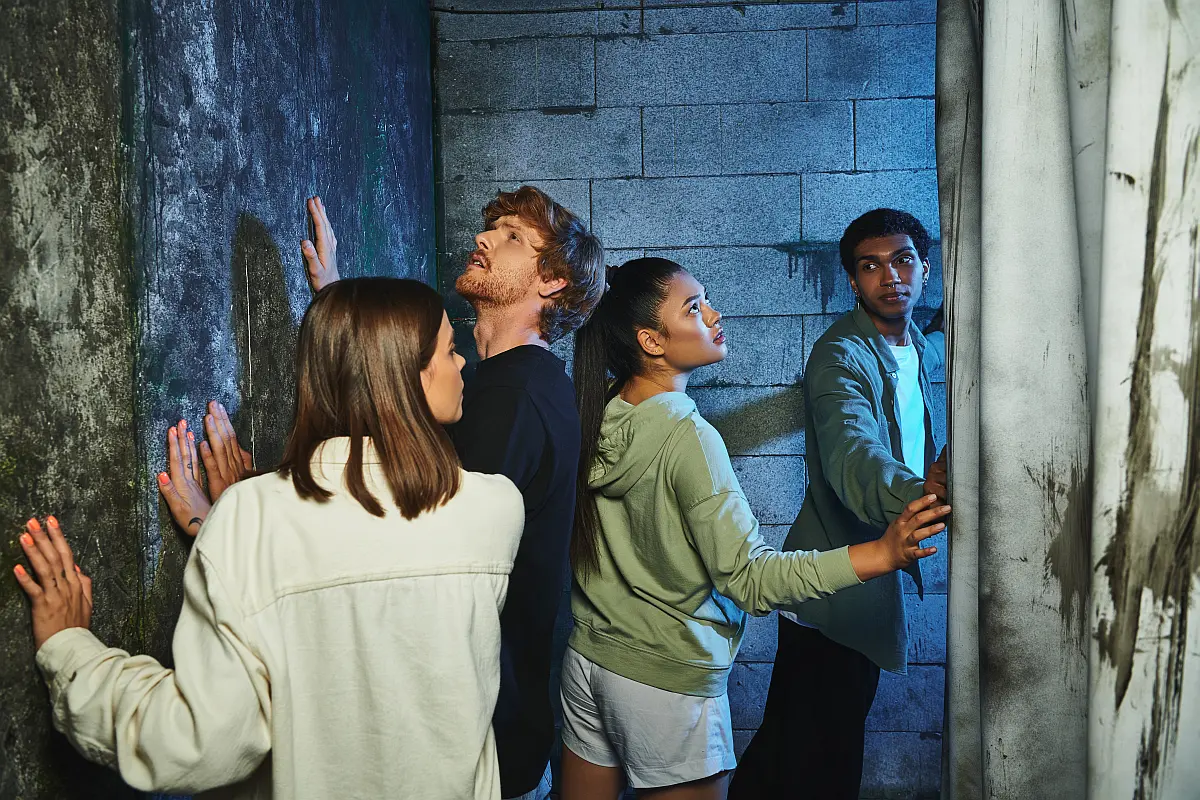
An escape room is a team game in which participants must solve a series of riddles, clues and puzzles inside a themed space (physical or virtual) in order to complete a goal – “escape” from the room, find an object, defuse a countdown – within a time limit, usually between 45 and 75 minutes.
45–75 min
usual time limit
3
formats: in person, virtual, hybrid
The core mechanics combine several types of challenge: logic puzzles, searching for hidden clues, piecing together information spread across different members of the group and, in many cases, simple physical challenges (finding objects, operating mechanisms). No participant has all the information needed on their own – the design makes solving the game depend on pooling what everyone knows.
Why it works as a corporate activity
An escape room takes what is essentially a team problem under pressure and turns it into a game: information spread out, limited time, and a common goal that can only be reached if the group coordinates its efforts. This makes it one of the few “game” activities that almost automatically produces behaviours you can observe and discuss afterwards: who takes the initiative, how tasks are shared out, what happens when someone finds a clue but can’t pass it on to the others in time.
Unlike many team building activities that require an explanation afterwards of “what we’ve learnt”, an escape room creates its own anecdotes – specific moments the team remembers and that become a shared reference (“remember when…?”) long after the event.
Types of escape room for companies
In person / virtual / hybrid
In person
The original format: the team goes to a physical space designed for the experience. It’s the most immersive format, because it combines the intellectual challenge with the physical side of the space (décor, real mechanisms, the feeling of being “inside” the story).
Virtual
An online adaptation, using platforms that recreate the logic of clues and puzzles through video calls and shared digital tools. It loses the physical element but keeps the collaborative problem-solving, and makes it possible to include geographically distributed teams.
Hybrid
Combines in-person elements (for example, a physical group in a room) with remote participants who provide information or solve parts of the challenge from outside, requiring coordination between the two groups.
Themed vs generic
Themed
The experience is set in a specific storyline (mystery, adventure, science fiction), with décor, sound and props that match the story. It adds immersion and usually makes the experience more memorable.
Generic
A format centred on the logic challenge without an elaborate storyline, usually easier to adapt to non-specialist spaces (offices, hotel meeting rooms) and therefore more flexible for companies that don’t want to depend on a specific venue.
Skills it trains
A well-designed escape room directly trains several key teamwork skills:
Communication
Especially communicating under pressure and with partial information: how to pass on what you know clearly and quickly when time is short.
Emerging leadership
In most groups, one person (or several) naturally starts coordinating the others – not necessarily whoever holds a formal leadership role day to day. This can be revealing both for that person and for the rest of the team.
Handling pressure
The time limit creates a moderate but real level of tension, and how the group handles it (gets more organised, freezes, splinters) is a small-scale reflection of how the team might behave under tight deadlines at work.
How to organise it with Impalaya
Impalaya designs escape room experiences tailored to the size and objective of the team – from themed formats in unique venues in Barcelona to more flexible versions that can run in non-specialist spaces. If your main objective is communication, or identifying leadership dynamics within the team, we can help you choose the format and difficulty level that best suit your group.